

A new article co-authored by former graduate students John Saunders, Hao Chen, Weijan Chen and undergraduates Chris Brauer and McGregor Clayton, describes the application of a new interferometric refractometer to one of the most ubiquitous polymers, i.e. silicone. In the article we use a new model based on the Lorenz-Lorentz equation to quantify the amount of organic vapours in the PDMS film and can even characterize the polymer restructuring that occurs when a guest molecule enters the polymer.
Read moreMahtab's visit comes to an end

After 6 months in our lab as a visiting student Mahtab Abtahi returns home. During the farewell lunch she was finally introduced to bubble tea. All the best, Mahtab, we hope to see you again soon!
Read moreCongratulations Dr. Crouse!

Congratulations to Jeff Crouse who successfully defended his PhD thesis
INVESTIGATIONS OF ICE PHOTODYNAMICS: MOLECULAR DYNAMICS STUDIES AND AN APPARATUS FOR SOLID SAMPLE VELOCITY MAP IMAGING
Jeff will take his expertise on theoretical and experimental physical chemistry to the Royal Military college as an instructor in Quantum Chemistry and to the University of Waterloo as a postdoctoral fellow.
Read moreCelebrating Undergraduate Research

From left to right: Sarah Denotter, Andrew Williams, Cameron Reid, Emily Groper, Omar Yaman.
Five excellent students from our lab will be presenting their projects today at the annual Queen's Chemistry Undergraduate Poster Session. This departmental tradition allows students completing a 4th year project to present their research to friends and colleagues. Come join us today in the 4th floor lounge to hear more about their work!
Read moreVisit by Jean-Pierre van Helden

It was wonderful to host Prof. Jean-Pierre van Helden (IPT Greifswald and University of Greifswald) when he visited Queen's on August 8th, 2017. Before giving a seminar on cavity-enhanced spectroscopy and its application to plasma science, he had a chance to travel through the 1000 Islands on a scenic boat cruise.
Read moreAn encoded light source speeds up fluorescence measurements
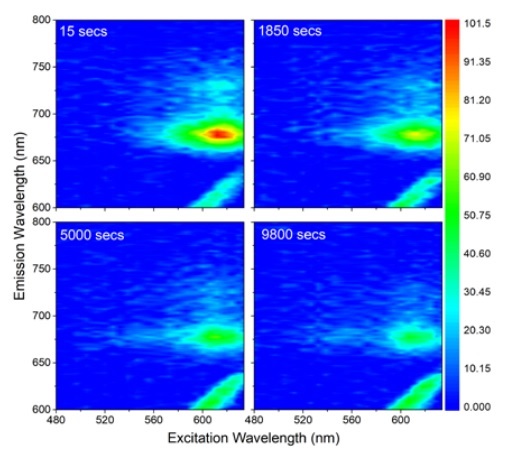
Although traditional 3D fluorescence spectroscopy is a powerful analytical technique, it is also notoriously slow, making it inappropriate for kinetic studies. Our paper presents a much faster way to collect 3D fluorescence measurements, using Hadamard 'barcodes' to encode a white light source and the corresponding fluorescence signal. In this work, we used a submersible fiber-probe to measure both the degradation kinetics of spinach extract in acid, and the thermal degradation kinetics of rhodamine B.
Read moreLoockLaserLab goes paddling
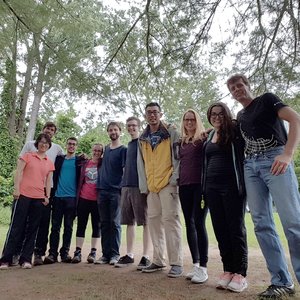
We speculated that "30% chance of rain" means 70% chance of not getting soaked. Luck was against us, but we had fun (including "type-2 fun"), anyway. The all-day adventure ended in a pub - as indeed all good adventures do!
Read moreCatching up at CES 2017

Guess where the Cavity Enhanced Spectroscopy Conference and Summer School was this year? (Hint: windmills in the background..!). Aside from learning a lot of exciting science it was also wonderful to catch up with friends and collaborators. Gianluca Gagliardi looks a lot more composed on this selfie, but he also didn't have to figure out how the camera on the new cell phone worked...
Read moreJoin us at AIO
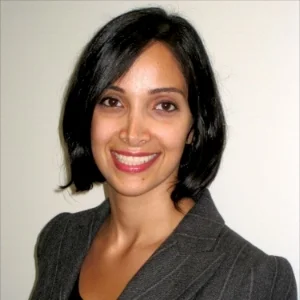
Our postdoctoral fellow, Dr. Sogol Borjian, is one of this year's program chairs at the 2017 Applied Industrial Optics (AIO) meeting in San Francisco, CA. Two of our group members, Sogol and Amy, will be giving oral presentations at the conference. We hope to see you there!
Read moreCongratulations Sean!
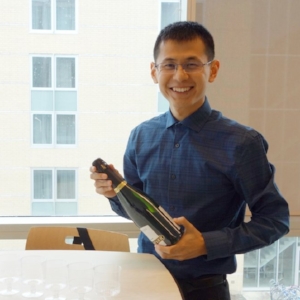
On March 27, Sean successfully defended his M.Sc thesis. In his thesis research, he used Silicon-on-Insulator (SOI) devices to detect lead and mercury in water. Congratulations, Sean!
Read moreUnderground Fluorescence →
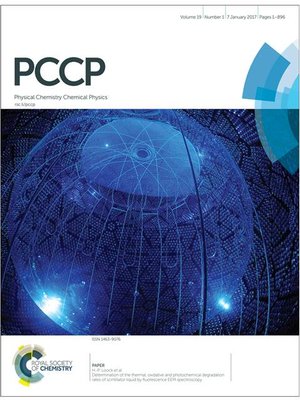
To detect and study neutrinos over the course of several years, SNO+ proposes to 'light up' neutrinos in an underground sphere by filling it with 780 tons of a fluorescent cocktail. Our paper examines the degradation of this cocktail over time. In his work, Nic Andrews uses a submersible fiber-probe to measure the fluorescence excitation emission matrix spectrum of the cocktail as it is thermally and oxidatively degraded. (PCCP 19(1) 2017)
Read moreCongratulations Dr. Andrews!
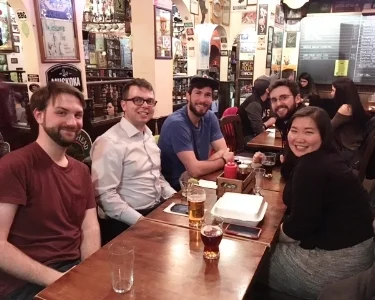
On January 27, 2017, Nic Andrews successfully defended his Doctoral thesis. Among the many projects in his thesis, Nic helped develop a Hadamard-Transform EEM spectrometer to increase the collection time of 3D fluorescence data by one hundred fold. Congratulations, Nic!
Read moreCongratulations Dr. Saunders!

On September 23, 2016, John Saunders successfully defended his Doctoral thesis. Among the many projects in his thesis, John helped to characterize and develop films for optical sensing, by studying their properties as they swell. Congratulations, John!
Read moreCongratulations Annica!

On August 2, 2016, Annica Freytag successfully defended her Master's thesis. In her thesis, she used a laser-excited cantilever to measure the viscosity and density of different liquids. Congratulations, Annica!
Read more